Buckling of embedded threads
|
(FYP)Fathullah Farid
|
|
|
Melvin Chua (FYP)
|
Kiong JY Michael (FYP)
|
|
|
|
|
|
|
Twist-Induced Buckling Instability and Morphological Phase Transitions in Hyperelastic Filaments
J. Appl. Mech. Dec 2025, 92(12): 121004
|
|
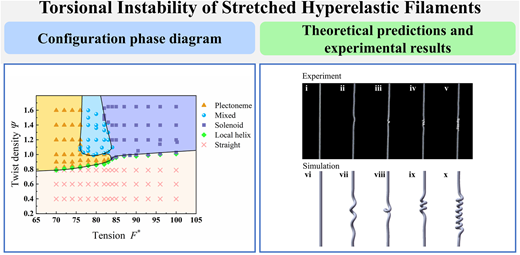
Under large torsional deformation, hyperelastic filaments exhibit spontaneous knotting and complex morphological transitions, particularly under axial loads and self-contact. However, the post-buckling behavior and configuration evolution of the hyperelastic filament differ significantly from those observed under small deformation, particularly when self-contact is considered. Here, we develop a numerical framework combining Cosserat rod theory and Mooney–Rivlin hyperelasticity to simulate buckling and post-buckling behaviors of hyperelastic filaments under torsion, explicitly resolving self-contact via a centerline-based discretization. Torsional experiments on rubber filaments under given axial loads are performed to validate the numerical results. The model predicts the buckling and post-buckling behaviors of twisted rubber filaments under prescribed axial loads. A unified morphological phase diagram, mapping five distinct configurations (straight, localized helix, plectoneme, solenoid, and mixed), is experimentally validated and theoretically predicted. This work provides insights into comprehending the intricate morphological nature of constrained soft rods.
|
Twist-Induced bifurcation and path manipulation in compressed ribbons
|
扭转与重力如何操控材料的“变形密码”?
|
In this paper, we investigate the nonlinear behaviour of ribbons subjected to coaxial compression and twisting through theoretical, numerical, and experimental approaches. Using anisotropic Kirchhoff rod theory and continuation techniques, we construct global bifurcation diagrams and identify stability transition points via the conjugate-point test. Here, we show that the twist induces supercritical pitchfork bifurcations in ribbons, giving rise to a rich landscape of multi-stability with up to four coexisting stable states. With increasing twist, we observe stability transitions between the fundamental and second Euler buckling modes. Moreover, gravity triggers a global bifurcation reconstruction characterized by the emergence of saddle-node bifurcations. These gravity-induced transformations allow for multiple, controllable snap-through pathways between stable states. We extend a mixed-curvature-based numerical optimization method to predict snap-through destinations and propose a general path-planning framework to navigate between stable configurations. Experiments on ribbons with varied aspect ratios corroborate the theoretical predictions and demonstrate the viability of programmable transitions in multi-stable systems. Our findings provide new insights into bifurcation and snap-through behaviour in slender structures, with potential applications in mechanical metamaterials, flexible electronics, and soft robotics.