2010 |
|
|
Shape memory materials, Materials Today, Volume 13, Issues 7–8, July–August 2010, Pages 54-61
|
After being severely and quasi-plastically distorted, shape memory materials (SMMs) are able to recover their original shape at the presence of the right stimulus. In recent years we have seen significant progress from shape memory alloys (SMAs) to shape memory polymers (SMPs). In this paper, we summarize the most recent advances in SMMs. The focus is on the new features found in traditional SMMs, namely SMAs and SMPs, and a newly emerging type of SMM, namely shape memory hybrid (SMH), which enables enthusiasts to design SMMs with tailored properties/features for a particular application without the aid of experts (“do-it-yourself” manner).
|
|
Shape memory polymer with rubber elasticity
CN101985518B
|
The invention discloses a shape memory polymer with rubber elasticity, which relates to a memory material. The shape memory polymer has high elastic performance at high and low temperatures. The components of the shape memory polymer include organosilicon or organic adhesive and ethylene vinyl acetate or a composite or mixture of ethylene vinyl acetate, such as hot melt glue. The hot driving temperature of the polymer is the melting or softening temperature of the ethylene vinyl acetate or the composite or mixture of ethylene vinyl acetate and is realized by selecting the ethylene vinyl acetate or the composite or mixture of ethylene vinyl acetate with the corresponding melting or softening temperature; and the volume ratio of the organosilicon or organic adhesive to ethylene vinyl acetate or the composite or mixture of ethylene vinyl acetate is 10:1 to 1:1. The shape memory material solves the problem of quasi plastic deformation or brittle break at a low temperature (lower than the shape restoration temperature) of the conventional shape memory material (such as alloy and polymer). The shape memory polymer has high elasticity like rubber at both high and low temperatures.
|
2011 |
Water-responsive shape memory hybrid: design concept and demonstration, eXPRESS Polymer Letters, Vol. 5, No. 5, 2011, pp409-416
|
Shape memory materials are featured by their ability to recover their original shapes when a particular stimulus, such as heat, light, magnetic field, even moisture/water, etc. is applied. However, it is not an easy task for non-professionals to synthesize a shape memory material which can meet all the requirements of a particular application. Even for professionals, like materials researchers, it could involve tedious trial and error procedures. In this paper, the concept of water-responsive shape memory hybrid is proposed and the advantages are demonstrated by two examples. The hybrid concept is versatile and can be easily accessed by those even without much polymer/chemistry background. Moreover, the performance of such hybrids can be well-predicted. This concept can be further extended into solvent-responsive shape memory hybrids, which can be routinely designed and realized in a Do-It-Yourself manner by almost anyone.
|
2012 |
Ding Z (2012) Shape memory hybrids : mechanism and design
for tailored properties, Doctoral thesis, Nanyang Technological University, Singapore. |
The concept of shape memory hybrid (SMH) is proposed. The underlying mechanism and performance are investigated. The flexibility and versatile in design and fabrication of SMHs with tailored properties are demonstrated in a silicone based system. All types of shape memory phenomena, namely dual-shape memory effect (SME), triple-SME, and mechanical two-way SME, which are most likely found separately in some individual existing shape memory materials (SMMs), but not all in one material, are reproduced in SMHs made of silicone-paraffin wax (S-PW). The underlying mechanisms behind all these phenomena are revealed in details. In addition, the performance of S-PW SMHs is systematically characterized. Multiple-stimuli-responsive SME is achieved in a silicone-sodium acetate trihydrate (S-SAT) SMH, which is not only thermo-responsive and water-responsive, but also pressure-responsive. The last shape memory feature has never been realized in any existing SMMs. Beside the ability for mechanical two-way actuation, shape fixation of S-SAT SMHs can also be quickly achieved by means of tapping. Silicone and melting glue (S-MG) SMHs developed here are not only rubber-like at both high and low temperatures, but also have excellent SME and repeated instant self-healing function. It is proved that while micro sized MG inclusions play a part in the SME, tangled molecular chains of MG (and silicone) contribute to the rubber-like phenomenon and repeated instant self-healing function. Based on the working principle of SMHs, electrically conductive SMHs which are suitable for joule heating and with over-heating protection function, SMHs with a narrow transition temperature range (within 4.5oC), impact-responsive SMHs, high temperature SMHs, and heating/cooling-responsive SMHs are developed. This project presents a systematic study in design, fabrication and characterization of SMHs with tailored properties and features.
|
|
Cooling-/water-responsive shape memory hybrids,
Composites Science and Technology (2012) |
|
|
Heating/cooling-responsive shape memory hybrid (Silicone + Tin powder)
Left column: heating-responsive; right column: cooling-responsive 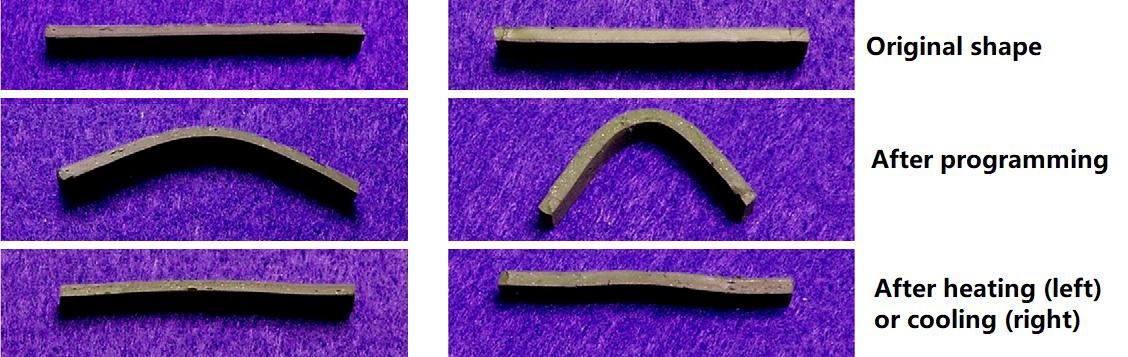
Stimulus-responsive shape memory materials: a review. Materials & Design Volume 33, January 2012, Pages 577-640
|
2017 |
SHAPE MEMORY PHENOMENON IN METALLIC MATERIALS
International Journal of Recent Development in Civil & Environmental Engineering, 3(2), 2017, 28-32 |
Titanium implanted with Tin
|